Map the stages before you change anything
Before you write a new process, map the one you already have. Look at the last ten opportunities the agency worked on, won and lost, and write down the stages each one passed through. You will usually find that the real process is simpler than the one people describe, and that a few stages are being skipped or repeated.
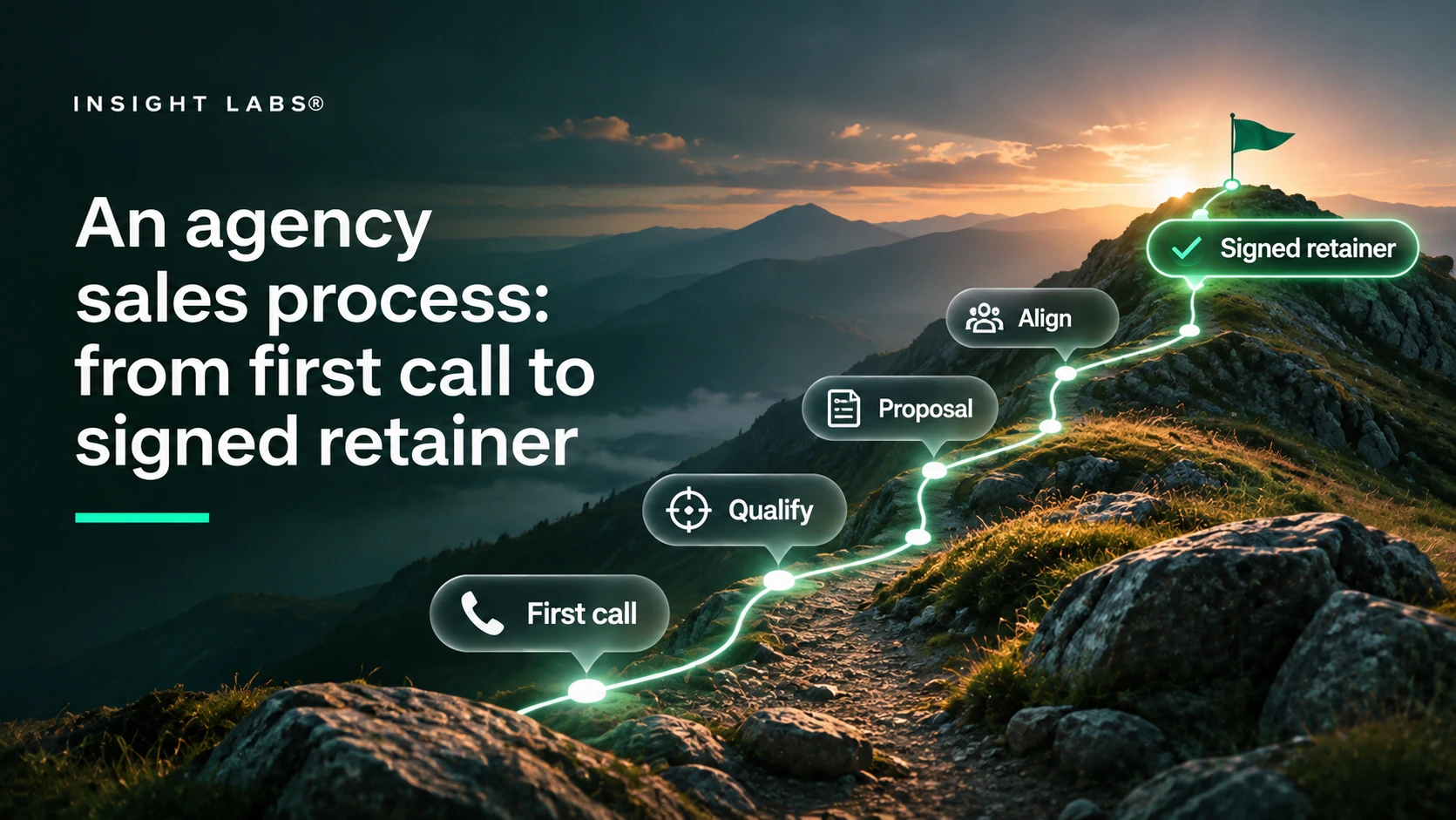
For most agencies a sensible process has six stages:
- First call: the opportunity is identified and qualified.
- Discovery: the agency learns the goal, the constraints and the decision process.
- Proposal: a written recommendation, with options and a price.
- Pitch or review: the proposal is discussed with the people who will decide.
- Decision and contract: the client agrees the work and signs.
- Handover: the opportunity moves to delivery with a clear brief.
Each stage should have an exit criterion, which is the evidence needed to move on. If you cannot say what good looks like at the end of a stage, the stage is not defined yet.
Qualify on the first call
The first call is where most of the wasted effort begins. A conversation that should have ended after ten minutes often runs to an hour and then leads to a proposal nobody reads. A short qualification routine protects the team's time and gives the client a sense of how you work.
Ask five questions early, and write the answers down:
- What is the business goal, in numbers the client already tracks?
- Who will approve the spend, and who else needs to be involved?
- What budget has been agreed, and when is the decision expected?
- What has been tried before, with which agency or in-house team, and what did it deliver?
- What would make them switch to a new partner?
If the answers are vague, it is reasonable to ask for a follow-up conversation with the decision-maker before going further. If the answers show a clear need, a real budget and a sensible timeline, move the opportunity forward with confidence. The purpose of the first call is to decide what the next step should be, not to sell.
Make discovery earn the proposal
Discovery is the stage where the agency learns enough to write a useful proposal. It is also where many proposals are lost, because they are written before the agency understands the client well enough to make a credible recommendation.
A good discovery session covers the commercial goal, the current performance, the channels and partners involved, the internal capacity and the risks. It ends with the agency summarising what it has heard and asking the client to correct anything that is wrong. That summary becomes the basis for the proposal.
Discovery should also test the target. If the goal and the budget do not match, the proposal needs to say so and offer options, such as a smaller target, a larger budget or a phased plan. Proposals that ignore a mismatch tend to be ignored themselves.
Write a proposal with one clear next step
A proposal is a decision document. It should help the client decide, and it should show them exactly what happens if they say yes. The most common mistake is to write a long, generic document that describes the agency rather than the client's problem.
Keep the structure tight:
- A one-page summary of the goal, the current position and the recommendation.
- Two or three options, each with scope, timing, price and the expected range of results with the assumptions behind it.
- The team, the reporting and the review points.
- One clear next step, such as a decision meeting on a named date.
Do not send a proposal by email and wait. Walk the client through it, or ask for a short review meeting, and agree the decision date during that conversation. A proposal without a booked next step is the most common reason an agency loses momentum.
Close without discounting
When a proposal stalls, the instinct is to discount. It is almost always the wrong move. A discount tells the client that the price was padded, it trains them to ask for a discount next time, and it reduces the margin the agency needs to deliver well.
Instead, return to the decision. Ask what is holding the client back: the price, the scope, the timing, the internal approval or a concern about the team. Each of these has a different answer. A lower price is only one of them, and often it is not the real issue. A smaller first phase, a clearer reporting plan or a named account lead can resolve many objections without changing the price.
If you do need to offer something to close, make it a trade. Ask for a longer commitment, a faster decision or a case study in return. That keeps the value of the work visible and protects the agency's position for the next client.
Hand over to delivery with a written brief
The sale is not finished until the work starts well. Many agencies lose clients in the first weeks, not because the work is poor, but because the handover was vague. The delivery team did not know what had been promised, and the client was not sure who to contact.
A written handover pack should include the agreed goal, the scope, the success measures, the reporting schedule, the named people on both sides, the first set of actions and the decisions still to be made. The sales lead should walk the delivery lead through the account, and the client should be introduced to the delivery team before the first piece of work begins.
Treat the first month as a test of the relationship. Hold the first review on the agreed date, report on what has been done and what it has shown, and ask the client what they would like to change.
Run a weekly pipeline review
A sales process only works if someone checks it. A short weekly review, usually thirty minutes, keeps the pipeline honest. It should cover every open opportunity, its stage, how long it has been there, its next step and its date.
Three questions make the review useful:
- Which opportunities have moved since last week, and what caused it?
- Which opportunities have no next step, or have had none for more than a week?
- Which opportunities should be closed, because the client has gone quiet or the fit is wrong?
Stalled deals are the most valuable thing the review finds. An opportunity that has sat in one stage for a long time is either about to die or about to be won, and it needs a decision either way. Be willing to close opportunities that will not move. That frees the time for the ones that will.
Measure the stages that matter
Measure the process by stage, not only by the final result. The useful measures are the conversion rate from one stage to the next, the time each opportunity spends in each stage, the average deal value, the win rate by source, and the revenue retained after the first year.
Conversion by stage shows where the process is leaking. If many first calls become discoveries but few discoveries become proposals, the discovery stage needs work. If proposals are sent often but rarely reviewed, the proposal stage needs work. Time in stage shows where the team is slowing down. Win rate by source shows which referral partners, channels or content are producing the best clients.
Review these measures monthly, and change one thing at a time so that you can see what made the difference.
Common leaks and how to close them
Most agency sales processes leak in the same few places. The first is the proposal with no next step, covered above. The second is the founder doing all the selling, which works until the founder is busy and then stops entirely. The third is the referral that is never followed up, which is often the best lead the agency will get.
The fourth is the lack of a pricing ladder. If every opportunity is priced from scratch, the agency spends its time negotiating rather than selling. A small set of tiers, with a clear scope for each, makes the conversation shorter and the outcome more consistent.
The fifth is the absence of CRM discipline. A simple pipeline in any tool will do, provided every opportunity has a stage, an owner, a next step and a date. Discipline matters more than the software.
Closing these leaks does not require a new team. It requires a written process, a weekly review and a willingness to say no to the opportunities that do not fit.
Put this into practice
If your agency's sales process depends on one person, or your pipeline has stalled, book a discovery call. We will look at how your opportunities move through the stages and agree which change would make the most difference first.
Talk about your agencyQuestions and answers
Which CRM should an agency use?
Any tool that lets you keep a pipeline with stages, owners, next steps and dates will do. The discipline of updating it every week matters far more than the product you choose.
Should the founder still sell?
Early on, usually yes. As the agency grows, the founder should hand first calls and discovery to a named lead with a written playbook, and step in for the largest and most complex opportunities.
How should referrals be handled?
Treat them as a source with its own stage. Record who referred the opportunity, thank them, and agree a follow-up within a set period. Referrals are often the highest-value leads, so they should not be left in an inbox.
How do we know if the process is working?
Look at conversion by stage, time in stage and win rate by source each month. If those numbers improve after a change, the change worked. If they do not, look at the stage where the leak is largest first.