Why a long sales cycle needs a plan
In a short sale, marketing can be judged on enquiries. In a manufacturing sale that runs for months, with technical approval, supplier onboarding and budget sign-off, an enquiry is only the start. Most of the work happens before a buyer makes contact, and much of it happens without your sales team in the room.
The research points the same way. Gartner found that 67% of 646 B2B buyers surveyed in late 2025 would prefer to buy without a sales rep (Gartner, 2026). The Edelman and LinkedIn study of hidden buyers, the people who shape a decision without being the main contact, found that 71% of them have little or no interaction with sales representatives (ContentGrip, 2025). Both are cross-sector studies rather than manufacturing-only surveys, but they describe a buying group that forms its view largely from what it can find for itself.
The same Edelman and LinkedIn research found that more than 40% of B2B deals stall because the buying group cannot agree internally (Edelman and LinkedIn, 2025). In other words, losing to a competitor is not the only risk. A deal can also die quietly because one person in the group never got the information they needed.
Map the buying group first
Before you plan any activity, write down who is involved in a typical sale. LinkedIn's research puts the usual number at six to ten stakeholders (LinkedIn, 2024). Most manufacturing buying groups include:
- An engineer or technical lead, who checks specification, tolerances and materials.
- An operations or production lead, who checks lead times, capacity and continuity of supply.
- A procurement lead, who checks commercial terms and supplier approval.
- A quality or compliance lead, who checks certifications, traceability and audit history.
- A finance contact or director, who signs off the spend.
Match touchpoints to each stage
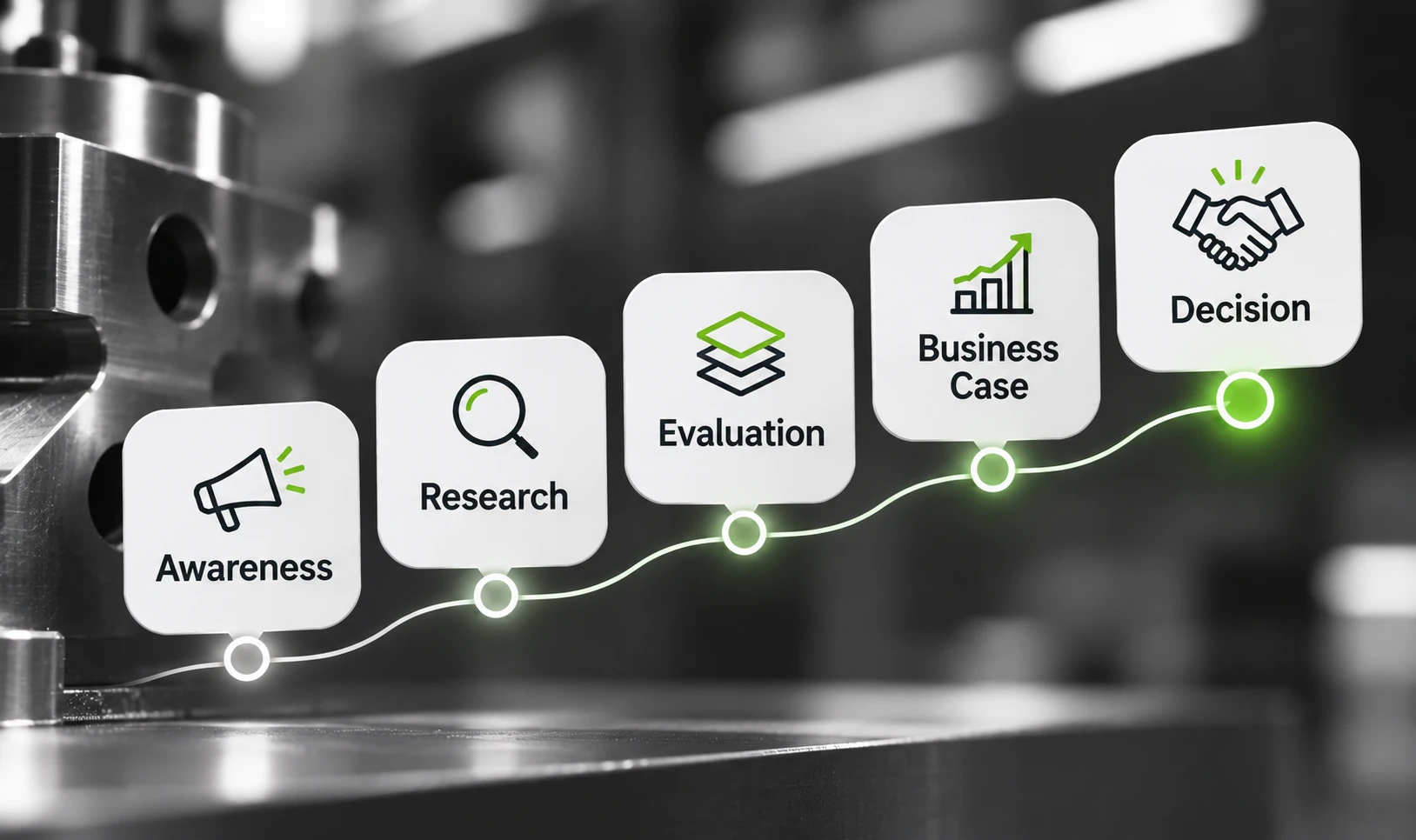
Each stage of the sale needs different content. Research needs clear capability pages. Shortlisting needs case studies and certifications. The technical check needs specifications and samples. The commercial check needs clear terms. If a stage has no matching content, the sale slows or stalls.
A simple way to find the gaps is to build a grid with the buying group down one side and the stages across the top, then write in each cell the question that person asks at that stage and the page or asset that answers it. Empty cells are the work. For example, a hypothetical supplier of fabricated steel assemblies might find it has strong capability pages and case studies, but nothing that answers a procurement lead's questions about supplier approval, insurance and payment terms.
- Research: capability pages, sector pages and plain answers to common technical questions.
- Shortlisting: case studies, certifications, customer sectors and the team behind the work.
- Technical check: specification sheets, tolerances, materials, drawings and sample requests.
- Commercial check: lead times, minimum order quantities, terms and supplier approval documents.
- Sign-off: a short summary a director can read in two minutes, with the business case.
Use channels for each stage
Search captures research, and paid search captures people who are already looking for a supplier. Content and LinkedIn reach the wider buying group. Our manufacturing SEO, manufacturing PPC and AI search work cover the channels in more depth.
AI assistants now sit inside that research stage. Ofcom reports that ChatGPT had 1.8 billion UK visits in the first eight months of 2025, up from 368 million in the same period of 2024 (Ofcom, 2025). Gartner found 45% of B2B buyers had used AI tools during a recent purchase (Gartner, 2026). When an AI summary appears in Google, people click on a traditional result in 8% of visits, compared with 15% when there is no summary, according to a US study of 900 adults' browsing (Pew Research Center, 2025). Your capability pages need to be clear enough to be cited, not only ranked.
Brand familiarity matters too. Only about 5% of a B2B market is likely to be buying at any one time (Ehrenberg-Bass Institute, 2025), and in LinkedIn's 2024 study of senior technology buyers, 81% said the product they bought was known to the whole buying group on day one (LinkedIn, 2024). Channels that keep you familiar to the other 95% are part of the pipeline, even if they do not produce enquiries this month.
Track pipeline by stage, not just leads
A lead count hides most of what matters. Report the number of opportunities at each stage, how long deals stay in each stage, and where each opportunity came from. A slow stage often points to a content gap, not a sales problem.
For example, imagine a hypothetical manufacturer that opens 40 opportunities a quarter. If 30 reach technical review but only 10 reach a quote, the problem sits between those two stages: perhaps specification sheets are missing, or sample requests take too long. More enquiries would not fix that. Better technical content would.
Feed those stages back into the ad platforms where you can. Google Ads supports enhanced conversions for leads, which uses data such as email addresses to match offline outcomes from your CRM back to the original ad click, and Google recommends upgrading older offline imports to it (Google Ads Help, 2026). That lets bidding learn from qualified opportunities rather than raw form fills.
- Opportunities created per month, by source.
- Conversion rate from each stage to the next.
- Average days spent in each stage.
- Number of contacts engaged per target account.
- Pipeline value and won revenue, by first and most recent source.
Plan for the long view
Because the cycle is long, early indicators matter. Watch for target accounts that visit the site, technical downloads from named companies and repeat visits from the same buying group. Review the plan each quarter, and give each channel a clear job in the pipeline rather than judging it on last month's enquiries. Our manufacturing pipeline service is built around this approach.
Agree those jobs with sales at the start. If LinkedIn's job is to keep the brand familiar to procurement leads in three sectors, report it on that. If paid search's job is to capture supplier searches, report it on qualified enquiries. Mixing those jobs up is how good channels get cut.
What good looks like is fairly simple to describe. Every opportunity in the CRM has a source and a stage. Sales and marketing agree on what each stage means and review the numbers together each month. Each member of the buying group has at least one page or asset that answers their main question. Target accounts are tracked as accounts, so you can see when a second or third person from the same company starts engaging. And the quarterly review asks two questions: which stage is slowest, and what content or channel change would speed it up. A plan built this way gets better each quarter, because every gap it finds becomes the next piece of work rather than a reason to change direction.
Common mistakes, and what to ask a supplier
The usual mistakes are planning for one contact instead of the group, measuring only leads, and cutting brand activity because it does not produce enquiries in the same month. Another is leaving sales out of the definitions: if marketing and sales disagree on what counts as a qualified opportunity, the reports will never be trusted.
If you are working with an agency, ask how they will map your buying group, which stage each channel is responsible for, how they will connect activity to opportunities in your CRM, and what early indicators they will report before revenue appears. A good partner will want to see your pipeline data, not just your website analytics.
Put this into practice
Book a discovery call and we will review your channels and results first, then agree what to test.
Plan your manufacturing pipelineQuestions and answers
How long does a manufacturing sale usually take?
It varies widely by product, value and whether supplier approval is needed. Plan across several months, and measure the time deals spend in each stage so you can see where time is lost and which content would shorten it.
Which metric matters most?
Qualified opportunities at each stage, with the source recorded. It shows which activity moves deals forward, which a lead count does not. Add stage conversion rates and days in stage once the basic tracking is reliable.
How many people are in a typical buying group?
LinkedIn's research puts a typical B2B buying group at six to ten stakeholders. In manufacturing that usually covers engineering, operations, procurement, quality and finance, each with different questions that need answering before a purchase order is raised.
Why do manufacturing deals stall?
Often because the buying group cannot agree, not because a competitor wins. Edelman and LinkedIn research found more than 40% of B2B deals stall for that reason. Content that answers each person's questions helps the group reach a decision.
Does AI search change pipeline planning?
Yes. Buyers increasingly use AI assistants during research, and Gartner found 45% had used AI tools in a recent purchase. Clear, specific capability pages are more likely to be summarised accurately, which helps you reach the shortlist.
References
- LinkedIn, "LinkedIn is the place to B2B at Cannes Lions 2024", 2024
- Gartner (reported by Digital Commerce 360), "B2B buyers prefer rep-free purchasing as AI reshapes sales", 2026
- ContentGrip, "Why B2B marketers need to rethink thought leadership for the hidden buyer era", 2025
- Edelman and LinkedIn (reported by Marketing-Interactive), "Over 40% of B2B deals stall due to hidden buyers", 2025
- Ofcom, "Online Nation 2025", 2025
- Pew Research Center, "Google users are less likely to click on links when an AI summary appears in the results", 2025
- Ehrenberg-Bass Institute, "The 95:5 rule: why B2B growth starts long before the purchase", 2025
- Google Ads Help, "How to upgrade offline imports", 2026
 Alexander