What an AI visibility audit is, and why it is worth doing
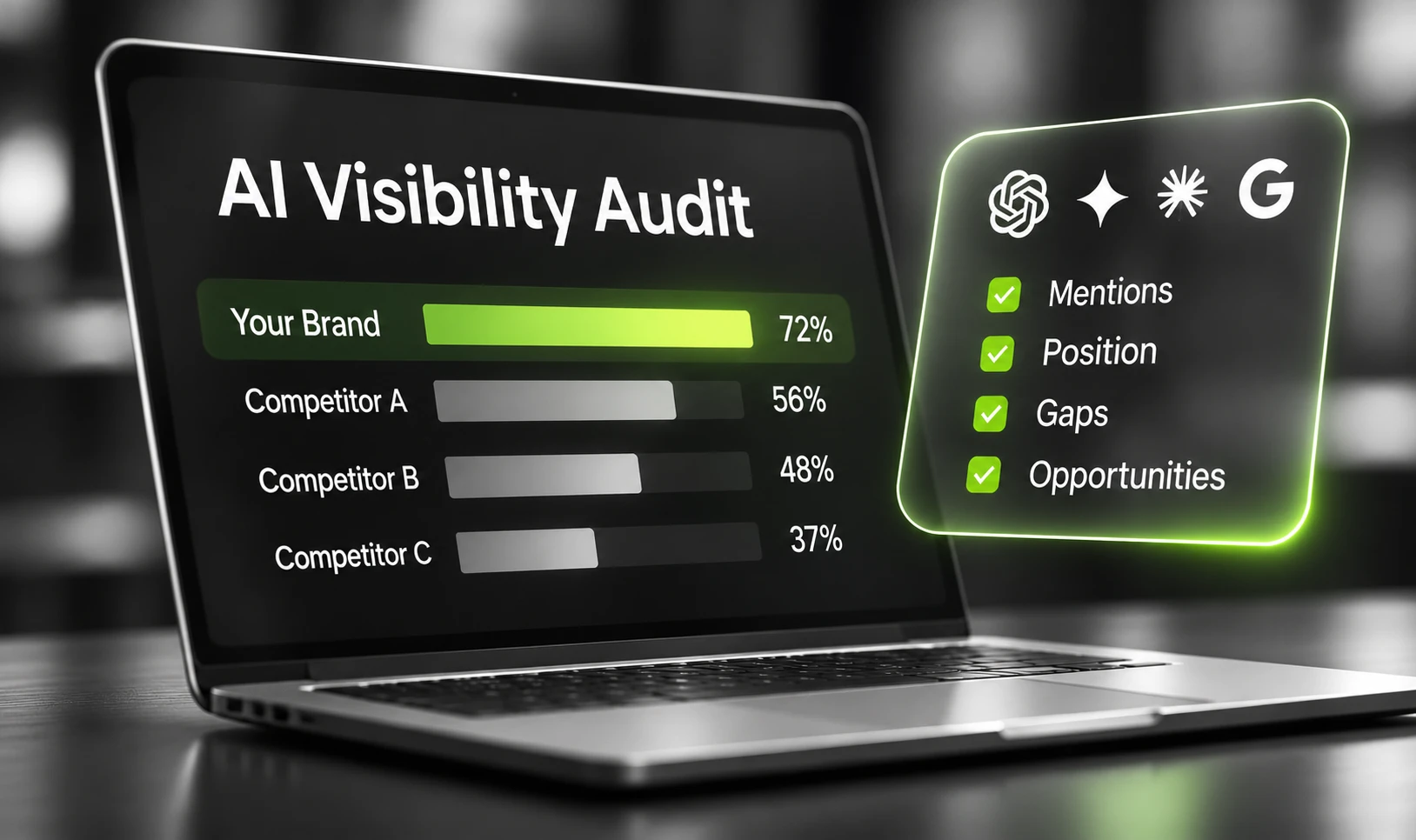
An AI visibility audit is a structured test. You take the questions your buyers ask, put them to the AI tools they use, and record which brands are named, how they are described and which sources are cited. Then you compare your results with those of the competitors buyers also consider.
The reason to do it is that more of the shortlist now forms inside AI answers. In G2's 2026 survey of 1,076 B2B software buyers, 51% said they start research with an AI chatbot more often than with Google, up from 29% the year before, and 69% said a chatbot recommendation had led them to choose a different vendor from the one they first planned (G2, 2026). That is a survey of software buyers by a review platform, but the trend is visible in consumer data too. BrightLocal's 2026 survey of 1,002 US adults found 45% had used AI tools for local business recommendations, up from 6% in 2025 (BrightLocal, 2026).
Search is also changing under your feet. In the UK, about 30% of Google searches now show an AI Overview (Ofcom, 2025), and Pew Research Center found that US users clicked a traditional result on 8% of visits when an AI summary appeared, against 15% without one (Pew Research Center, 2025). An audit tells you whether you are in the answer people now read first.
Step 1: choose the questions that matter
Start with commercial questions, not vanity terms. Examples include "which supplier makes precision parts in the UK", "which agency helps manufacturers generate pipeline" or "who can help us grow online sales". Aim for twenty to thirty questions across the buying journey: the problem, the options, the comparison and the final choice.
Write them the way buyers talk. Pew found that longer, question-style searches were far more likely to trigger an AI summary: 53% of searches of ten words or more produced one, against 8% of one- or two-word searches (Pew Research Center, 2025). Short keyword lists will understate how often AI answers appear in your category.
Include a few variations of each question. People phrase the same need in very different ways, and the audit should reflect that. Good sources for real wording include sales call notes, enquiry forms, site search logs and the questions customers ask your account managers. Group the final list by buying stage, so you can see later whether you are strong early in the journey but weak at the point of choice, or the reverse.
Step 2: pick the platforms and the competitors
Test the AI tools your customers actually use. For most businesses that means at least ChatGPT, Google AI Overviews and one other assistant such as Gemini, Perplexity or Claude. ChatGPT alone has more than 800 million weekly users, according to OpenAI (TechCrunch, 2025), and Google's AI Overviews appear inside the search engine most people already use.
Choose three to five competitors. Include the rivals you lose deals to, not only the biggest names. If you are unsure, the first round of testing will show you which brands AI tools treat as your peers, and that list is often a surprise.
Decide in advance how you will run the tests, and keep it the same each month. Note whether you are signed in or not, which model or mode you are using, and which country you are testing from. Answers can differ by location and settings, so a change in method can look like a change in visibility. If you sell in several countries or languages, treat each one as a separate audit with its own question list.
Step 3: run each question many times
This is the step most audits skip, and it is the one that matters most. AI answers vary between runs. SparkToro and Gumshoe ran 12 brand-recommendation prompts 60 to 100 times each across ChatGPT, Claude and Google's AI tools. The same prompt returned the same list of brands less than 1% of the time, and the same list in the same order less than 0.1% of the time (SparkToro and Gumshoe, 2026). Gumshoe sells AI tracking tools and the study is not peer-reviewed, but the implication is clear: a single test is an anecdote.
The same research found that the set of brands a tool considers is more stable than the order. So run each question several times per platform, ideally from clean sessions, and record the share of runs in which each brand appears. For a manual audit, five to ten runs per question per platform is a practical starting point. Record the platform, the date and the exact wording every time.
Step 4: score the answers
Score each run for your brand and for each competitor, using the same rules every time, so the results compare fairly. Write the rules down before you start, with an example of each score, so that two people scoring the same answer reach the same result.
- Named: the brand appears anywhere in the answer.
- Recommended: the answer suggests the brand as a supplier to consider, rather than mentioning it in passing.
- Described correctly: the description of the offer, location and audience is accurate and current.
- Cited: the answer links to a source that describes the brand, and you note which source.
- Sentiment: the tone is positive, neutral or negative, with any caveats noted.
Step 5: turn scores into a benchmark and act on the gaps
Add the scores up into a mention rate and a recommendation rate for each brand, by question and by platform. A simple share-of-voice view, your mentions divided by all brand mentions across the set, gives you one headline number to track. Keep the detail underneath it, because the actions come from the individual questions.
For example, a hypothetical engineering firm testing 25 questions, eight runs each on three platforms, would collect 600 answers. If it appears in 90 of them and its strongest rival appears in 240, the mention rates are 15% and 40%. Breaking that down by question might show the firm is well represented on technical questions but missing from every "who are the best suppliers" question, which points to a different fix than a general visibility problem.
Where competitors are named and you are not, study the sources the answer uses. Pew found that Wikipedia, YouTube and Reddit were among the most linked sites in AI summaries (Pew Research Center, 2025). In your category it may be trade press, review sites or industry directories. The gap is often a missing page, an out-of-date description, or no mention in the publications your buyers read. Fix the gap, then retest after a month.
Being cited may also help your search traffic. Seer Interactive's client data showed higher organic click-through rates when a brand was cited in an AI Overview than when it was not, although Seer notes that brand authority may explain both (Seer Interactive, 2025).
Common mistakes and what to ask a supplier
The common mistakes are predictable. Testing each question once. Testing only ChatGPT. Using short keywords instead of real questions. Tracking position in the answer as if it were a search ranking. Changing the question set every month so trends cannot be read. And reporting visibility without ever checking whether AI tools are sending visits: Adobe found traffic from generative AI sources to US retail sites rose 1,300% year on year over the 2024 holiday season (Adobe, 2025), so the referral line in your analytics is worth watching.
If you buy an audit or a tracking tool, ask how many runs it makes per question, which platforms it covers, whether it uses the consumer apps or the developer interfaces, and how it calculates its scores. The SparkToro and Gumshoe authors made the same recommendation: ask any provider to show its method and its maths. Our AI visibility service covers both the audit and the fixes that follow, and our free AI position report is a quick first look.
Put this into practice
Book a discovery call and we will review your channels and results first, then agree what to test.
Book a discovery callQuestions and answers
How often should we run an AI visibility audit?
Monthly is a sensible rhythm for most businesses. Run the same questions on the same platforms each time so the trend is clear, and add new questions only when your offer changes, keeping the core set fixed.
Do we need a paid tool to do this?
You can start manually with a spreadsheet and a fixed set of questions. Paid tools save time and run more repetitions across more platforms, but the method matters more than the tool. Ask any provider to explain exactly how it calculates its scores.
How many times should each question be run?
More than once. Research by SparkToro and Gumshoe found AI tools return the same brand list less than 1% of the time. For a manual audit, five to ten runs per question per platform is a practical start, and tools can run far more.
Which competitors should we include?
Include the three to five rivals you most often lose deals to, plus any brands that AI tools repeatedly name in your category during the first round of tests. The second group is often different from the competitors you expect.
What score should we aim for?
There is no universal benchmark. Aim to be named in a rising share of runs on your most commercial questions, with an accurate description on every platform. The useful comparison is against your direct competitors on the same questions.
References
- G2, "In the answer economy, don't win the click: win the answer", 2026
- BrightLocal, "Local Consumer Review Survey 2026", 2026
- Ofcom, "From apps to AI search: how the UK goes online in 2025", 2025
- Pew Research Center, "Google users are less likely to click on links when an AI summary appears in the results", 2025
- TechCrunch, "Sam Altman says ChatGPT has hit 800M weekly active users", 2025
- SparkToro and Gumshoe, reported by Search Engine Journal, "AI recommendations change with nearly every query", 2026
- Seer Interactive, "AIO impact on Google CTR: September 2025 update", 2025
- Adobe, "Adobe Analytics: traffic to US retail websites from generative AI sources jumps 1,200 percent", 2025
This article is adapted from ContxtAI's article on the AI visibility audit, rewritten for Insight Labs readers.

 Alexander