What an AI visibility tool actually measures
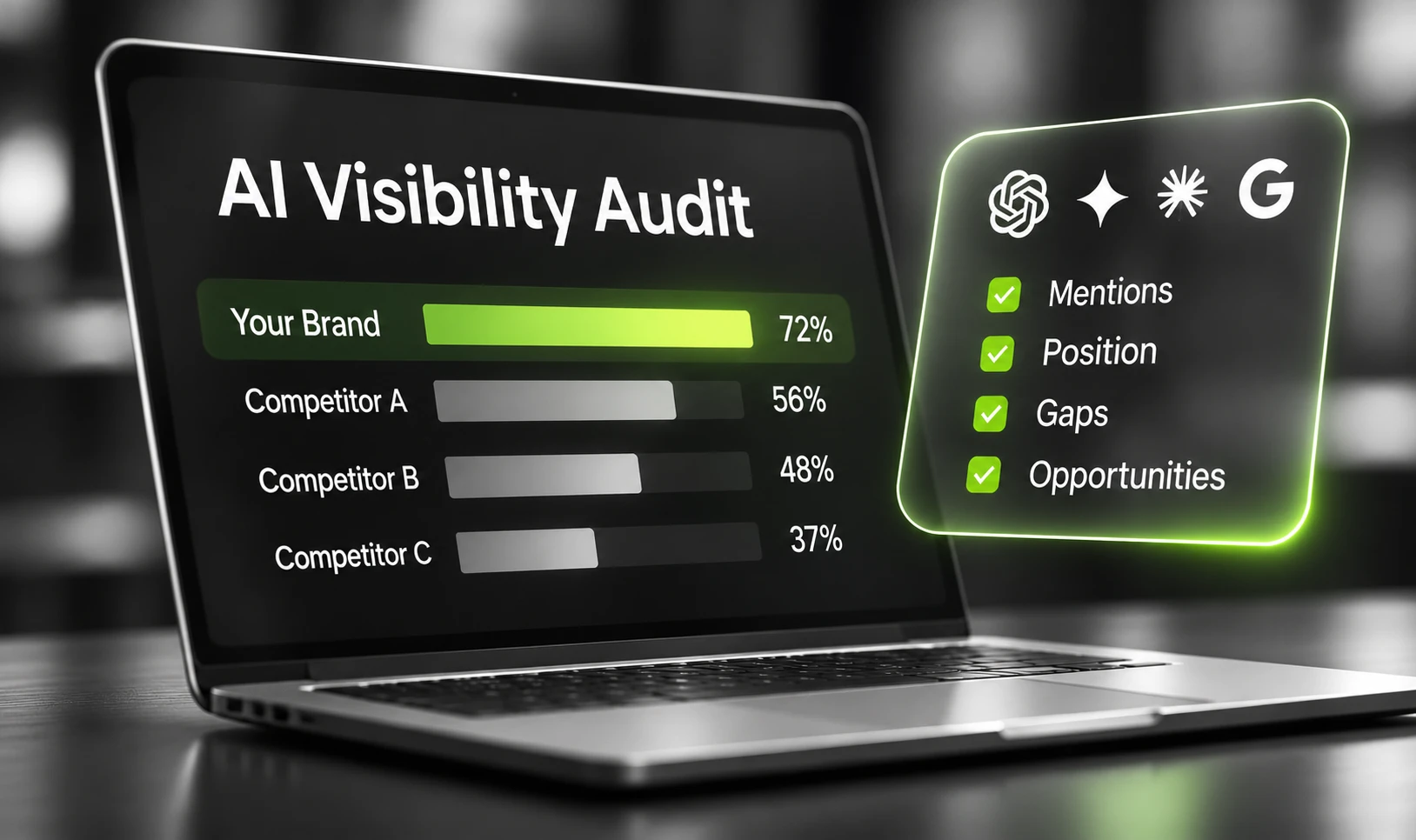
An AI visibility tool runs a fixed set of questions through the AI platforms your buyers use, such as ChatGPT, Google's AI Overviews and AI Mode, Gemini, Copilot and Perplexity, and records what comes back. Because AI answers vary from one run to the next, a credible tool asks each question several times and reports how often your brand appears, rather than giving a single yes or no.
The output should be specific enough to act on. At a minimum, a good tool shows you:
- How often your brand is named for each question.
- How your brand is described, and whether that description is accurate.
- Which competitors appear alongside you, and how often.
- Which sources the answers cite, so you know where to build credibility.
- Whether the answer recommends you, simply lists you, or raises doubts about you.
Why B2B brands need this more than most
B2B buyers do most of their homework before they speak to a supplier. A 2024 vendor study by 6sense, covering B2B buyers in North America, EMEA and APAC, found that buyers were nearly 70% of the way through their purchase process before engaging sellers, that buyers made first contact more than 80% of the time, and that 81% already had a preferred vendor when they did (6sense, 2024). If preference forms during independent research, that research is where you need to be seen.
AI tools are now a large part of that research. Forrester's State of Business Buying 2024 reported that almost 95% of buyers expected to use generative AI to support their purchase decisions within the following year, and that an average of 13 people were involved in each buying decision (Forrester, 2024). The first figure is a stated intention rather than measured behaviour, but it shows the direction of travel, and a group of 13 people means 13 separate rounds of research.
Software buying gives the clearest view so far. In a March 2026 survey of 1,076 B2B software decision-makers, G2 found that 71% relied on AI chatbots somewhere in their research, 51% started research in a chatbot more often than in Google, and chatbots were the most commonly cited influence on which vendors made the shortlist, named by 54% (G2, 2026). G2 runs a software review platform and the sample is software buyers, so treat the figures as a strong signal for technology categories rather than a measure of every B2B sector.
A supplier missing from those early answers may never be invited to tender, and the sales team will never know why. Tracking visibility turns that invisible loss into something you can see, report and fix.
Why your analytics cannot see the problem
Web analytics only records visits that happen. When an AI answer satisfies the question, there is often no visit to record. Pew Research Center tracked the browsing of 900 US adults in March 2025 and found that people clicked a traditional search result in 8% of visits to Google pages with an AI summary, against 15% where no summary appeared. Links inside the summary itself were clicked in about 1% of visits (Pew Research Center, 2025).
Agency data points the same way. Seer Interactive, analysing 3,119 informational queries across 42 client organisations, reported that organic click-through rate on queries showing an AI Overview fell from 1.76% in June 2024 to 0.61% in September 2025 (Seer Interactive, 2025). That is one agency's client base rather than the whole market, but the size of the drop is hard to ignore.
In the UK, Ofcom reported that around 30% of searches now show an AI-generated summary, and that ChatGPT received 1.8 billion UK visits in the first eight months of 2025, up from 368 million in the same period of 2024 (Ofcom, 2025). Globally, OpenAI's chief executive said in October 2025 that more than 800 million people use ChatGPT every week (TechCrunch, 2025). Buyers are forming views in places your dashboard does not reach, which is why a separate measure is needed.
How to choose a tool without buying noise
Most tools look similar on a demo. Judge them on the points below, and test them on your own questions for a few weeks before you commit to an annual contract.
The last point on the list matters more than it looks. In an October 2025 study coordinated by the European Broadcasting Union and the BBC, journalists from 22 public service broadcasters in 18 countries assessed more than 3,000 answers from four AI assistants. They found that 45% contained at least one significant issue and 20% had major accuracy problems, such as outdated or invented details (EBU and BBC, 2025). The study tested news questions rather than questions about companies, but it shows why a mention is not the same as a correct description. A tool that only counts mentions will miss the answers that name you and get you wrong.
- The platforms it covers match the tools your buyers actually use.
- You can set your own question list, rather than relying on generic prompts.
- It explains how it counts a mention, including how many runs it makes per question.
- You can export the data and share it with sales and leadership.
- It shows change over time, not only a single snapshot.
- It stores the full answer text, so you can check accuracy rather than relying on a count.
Build the question set before you buy anything
The questions decide whether the data is useful. Write them the way a buyer would type them, not the way your marketing team would phrase them. G2's 2026 survey found that a buyer's first AI prompt was most often about the category (33%) or about a named competitor (31%), so both types belong on the list (G2, 2026). Spread the rest across the stages of a real purchase:
For example, a precision engineering firm with three sales reps might start with 25 questions: ten category questions, five problem questions, five comparisons against its three main rivals and five brand questions. Ask the sales team which questions prospects raise on first calls, and check the list against the enquiries that actually convert. Keep the list fixed for at least a quarter so the trend is fair.
- Category questions: "Which suppliers make [product] for [sector] in the UK?"
- Problem questions: "How do I reduce [problem] in [process]?"
- Comparison questions: "[Your brand] or [competitor] for [use case]?"
- Brand questions: "What is [brand] known for?" and "Is [brand] reliable?"
- Procurement questions: "What should I ask a [product] supplier before signing?"
How to measure it and report it
Keep the metrics few and stable so the trend means something. Most businesses need four, listed below, reported by question group rather than as one blended score.
Citations deserve close attention because they link visibility to traffic and to authority. Seer Interactive reported that brands cited in an AI Overview had a 35% higher organic click-through rate than brands that were not cited, based on Q3 2025 averages, though it notes it cannot prove the citation caused the difference (Seer Interactive, 2025). Separately, an Ahrefs analysis of 75,000 brands found that the number of web pages mentioning a brand correlated more strongly with appearing in AI Overviews (0.664) than the number of backlinks did (0.218) (Ahrefs, 2025). Both are vendor studies showing correlation, but they point to the same lever: being mentioned and cited in the right places.
Report monthly, alongside enquiries and pipeline, not on a separate slide nobody reads. Our marketing science team builds this kind of reporting so visibility sits next to commercial results.
- Mention rate: the share of runs in which your brand is named.
- Share of voice: your mentions as a share of all brand mentions across you and named rivals.
- Accuracy: the share of answers that describe your offer, sectors and location correctly.
- Citation share: how often your own pages, or pages that mention you, are cited as sources.
Turn the data into work, and avoid the usual mistakes
A tool only helps if the results change what you do next. Where a competitor is named and you are not, look at the sources the answer uses, then fix the gap. That usually means a clearer page on the topic, a case study with named outcomes, or a mention in the trade press buyers read. Our SEO and GEO work covers how those fixes are planned, and our GEO service focuses on being cited by AI tools.
Connect the results to pipeline on the B2B lead generation side, so you can see whether visibility gains bring in enquiries. Add "an AI assistant" as an option wherever you ask new enquiries how they found you.
The most common mistakes are predictable, and all of them are avoidable:
- Tracking generic prompts that no buyer would type.
- Changing the question list every month, which breaks the trend.
- Counting mentions without reading what the answer says.
- Treating one run as a result, when answers change between runs.
- Buying a tool before anyone owns the follow-up work.
Put this into practice
Book a discovery call and we will review your channels and results first, then agree what to test.
Get your free AI position reportQuestions and answers
Do we need a paid tool to track AI visibility?
No, but a tool saves time and keeps the method consistent. Many businesses start with a fixed list of questions tested each month in a spreadsheet, then add a tool once the process is clear.
How many questions should we track?
Start with twenty to thirty questions that match real buying decisions. Use the same list each month so the trend is fair, and add questions when your offer changes.
Which AI platforms should a B2B brand track?
Start with the ones your buyers use. For most UK B2B brands that means ChatGPT and Google's AI Overviews and AI Mode, plus Copilot where buyers work in Microsoft environments, and Perplexity or Gemini if the sales team hears them mentioned. Ask a few recent customers which tools they used when they last compared suppliers.
How long does it take for AI visibility to improve?
Expect months rather than weeks. Fixes to your own pages can show up once they are recrawled, but mentions in trade press, directories and review sites build slowly, and AI answers shift gradually as those sources accumulate. Track monthly and judge progress over a quarter.
Is AI visibility tracking the same as SEO reporting?
They overlap but are not the same. Strong SEO helps, because many AI answers draw on pages that already rank well. But AI assistants also lean on third-party mentions, reviews and directories that a rankings report does not show, and they can describe you inaccurately even when they name you. You need both measures.
References
- 6sense, "6sense Launches 2024 Buyer Experience Report Unveiling Global B2B Buyer Trends" (press release via Silicon UK), 2024
- Forrester, "To Master B2B Buying Mayhem, Providers Must Prioritize Buyers' Needs" (The State of Business Buying, 2024), 2024
- G2, "The Answer Economy: How AI Search Is Rewiring B2B Software Buying", 2026
- Pew Research Center, "Google users are less likely to click on links when an AI summary appears in the results", 2025
- Seer Interactive, "AIO Impact on Google CTR: September 2025 Update", 2025
- Ofcom, "From apps to AI search: how the UK goes online in 2025", 2025
- TechCrunch, "Sam Altman says ChatGPT has hit 800M weekly active users", 2025
- EBU and BBC, "Largest study of its kind shows AI assistants misrepresent news content 45% of the time" (announcement via VRT), 2025
- Ahrefs, "An Analysis of AI Overview Brand Visibility Factors (75K Brands Studied)", 2025
This article is adapted from ContxtAI's article on LLM visibility tools for B2B brands, rewritten for Insight Labs readers.
 Alexander