Why paid search still matters for B2B
B2B buyers do most of their research alone. Gartner found that 67% of 646 B2B buyers surveyed in late 2025 would prefer to buy without a sales rep (Gartner, 2026). When a buyer with that preference needs a supplier, a search engine is usually the first stop, and in the UK that mostly means Google: Statcounter put Google's share of UK search at 90.59% in October 2026, with Bing at 6.76% (Statcounter, 2026).
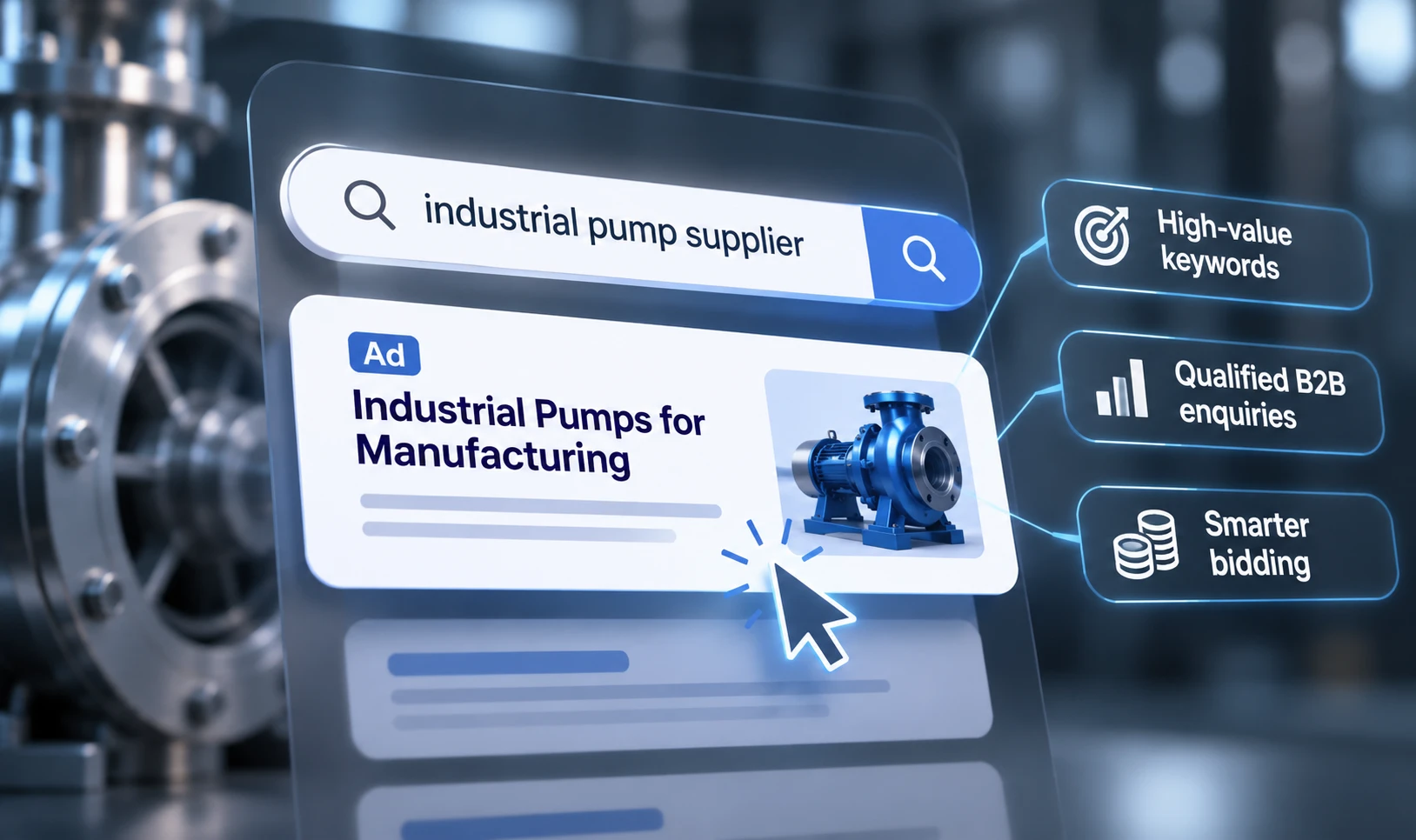
Paid search is different from most B2B channels because it responds to demand that already exists. Someone typing a specification, a process and a location into Google is telling you what they need. That makes it one of the few channels where a high-value enquiry can arrive within days of launch. Those searches are scarce: work from the Ehrenberg-Bass Institute suggests only about 5% of a B2B market is actively buying at any one time (Ehrenberg-Bass Institute, 2025). And because a typical B2B buying group has six to ten stakeholders (LinkedIn, 2024), the person searching is often gathering options to share with colleagues, so the page they land on has to work for readers who never saw the ad.
The search results page is changing, though. Ofcom reports that around 30% of keyword searches now return an AI-generated overview, and cites YouGov research finding 53% of UK people say they often see AI summaries (Ofcom, 2025). A US study by Pew found that people clicked a traditional result in 8% of visits when an AI summary appeared, against 15% when it did not, and that searches of ten words or more triggered a summary 53% of the time (Pew Research Center, 2025). Organic clicks are getting harder to win, which makes the paid placement, and the page behind it, more important.
Bid on intent, not just the product name
The most valuable B2B searches describe a need, a specification or a comparison. A bare product name can attract students, job seekers, competitors and people looking for a consumer version. Build your keyword list around terms that only a buyer would use:
- Specification searches, such as a material, tolerance or standard.
- "Supplier of" and "manufacturer in" searches, with your location or sector.
- Problem-led searches, where the buyer has a need but no supplier yet.
- Comparison searches, where you can explain honestly when you are the better choice.
- Certification and approval searches, such as a quality standard plus the process.
Send each click to a page that answers it
A generic home page rarely converts a high-value search. Each ad group should point to a page that matches the query, with the specification or sector, the proof, and a clear next step such as a call or a quote request. Negative keywords matter too: exclude job seekers, students and other terms that bring cheap, unqualified clicks. Our paid search service covers how the pages and keywords are planned together.
A good B2B landing page answers the questions a buyer would otherwise ask on the phone: what you make, to what tolerance or standard, for which sectors, in what volumes and with what lead time. It shows certifications and named sectors, and it offers more than one way to make contact, because an engineer may want a drawing review while a procurement lead wants a quote.
The ad itself should filter as well as attract. Mentioning the minimum order size, the sectors you serve or the standard you work to may lower the click-through rate, but it also stops people who were never going to buy from costing you money. In high-value B2B, a smaller number of better clicks is almost always the right trade, and the conversion rate on the landing page usually rises as a result.
Set the budget by the value of an enquiry
Work out what a qualified enquiry is worth to the business, based on average deal value, gross margin and close rate. That value sets the most you can pay for an enquiry. Optimising for the cheapest click usually brings the least valuable enquiries, so judge the campaign on cost per qualified enquiry instead.
For example, take a hypothetical engineering firm with an average first order of £30,000, a 30% gross margin and a close rate of one in five qualified enquiries. Each qualified enquiry is worth about £1,800 in first-order margin, before any repeat business. If half of all enquiries are qualified, the firm could pay up to £900 per enquiry and still break even on the first order. Most firms would set a lower target to leave room for profit, but the sum shows why a £15 click is not automatically expensive.
Benchmarks give a rough sense check. LocaliQ and WordStream's analysis of 13,474 US search campaigns from April 2025 to March 2026 found an average cost per click of $5.42, a conversion rate of 8.18% and a cost per lead of $66.69 across all industries (LocaliQ and WordStream, 2026). That is a US vendor dataset drawn from one company's client accounts, so it will not match a UK industrial niche, but it shows that a lead cost in the hundreds of pounds can be normal for specialist B2B terms.
Track qualified enquiries
Mark each enquiry as qualified or not in your CRM, and feed that back to the ad platform where it is possible. Ask sales which search terms produced the best conversations, and use that feedback to refine the list each month.
Google Ads supports enhanced conversions for leads, which matches offline outcomes from your CRM back to the original click using data such as email addresses. Google recommends upgrading older offline conversion imports to it, and from April 2026 enhanced conversions for web and for leads were merged into a single setting (Google Ads Help, 2026). Once qualified enquiries and won deals are flowing back, automated bidding can aim at the outcomes you care about rather than any form fill.
- Cost per qualified enquiry, by campaign and by keyword theme.
- Share of enquiries that sales accept as qualified.
- Opportunities and pipeline value from paid search, recorded in the CRM.
- Search terms report reviewed monthly, with new negatives added.
Connect paid search to the rest of the plan
Paid search shows you which questions buyers ask in their own words. Use those terms in your organic content and in your SEO and GEO pages, so the free and paid channels reinforce each other.
The search terms report is also a source of content ideas. Long, specific queries are the ones most likely to trigger AI summaries (Pew Research Center, 2025), so a page that answers them clearly can earn a place in the summary as well as the paid click. Over time, that lowers your dependence on paid traffic for the questions you answer best.
Common mistakes, and what to ask a supplier
The common mistakes are broad match keywords with no negatives, every ad pointing at the home page, success judged on clicks or cost per click, and conversion tracking that counts newsletter sign-ups as leads. Each one makes the account look busy while sales sees few useful conversations.
If you are choosing an agency, ask how they will define a qualified enquiry with your sales team, whether they will import CRM outcomes into Google Ads, how often they review search terms, and which landing pages they will build or change. Ask to see the cost per qualified enquiry each month, not only the cost per lead.
Put this into practice
Book a discovery call and we will review your channels and results first, then agree what to test.
Plan your B2B paid searchQuestions and answers
Is paid search worth it for B2B?
Yes, when the value of a qualified enquiry is high enough to cover the cost per click and the time spent on the account. Work out that value from your average deal size, margin and close rate before you set a budget.
How many keywords should we start with?
Start small, with a tight set of twenty to fifty terms tied to clear intent. Expand once you know which terms bring qualified enquiries, and add negative keywords every month as the search terms report shows what to exclude.
What is a normal cost per lead for B2B paid search?
It varies widely by sector and country. A US benchmark from LocaliQ and WordStream put the average cost per lead across industries at $66.69 for April 2025 to March 2026, but specialist B2B terms often cost more and can still be profitable.
Do AI overviews reduce the value of paid search?
They reduce clicks on organic results more directly. Pew found people clicked a traditional result in 8% of visits with an AI summary versus 15% without one. Paid placements and strong landing pages become more important as organic clicks fall.
Should we bid on Bing as well as Google?
Usually as a second step. Statcounter put Bing at under 7% of UK search in October 2026, but its audience can skew towards office desktops, so a small test with your best-performing keywords is often worthwhile.
References
- Statcounter, "Search engine market share, United Kingdom", 2026
- Gartner (reported by Digital Commerce 360), "B2B buyers prefer rep-free purchasing as AI reshapes sales", 2026
- Ofcom, "Online Nation 2025", 2025
- Pew Research Center, "Google users are less likely to click on links when an AI summary appears in the results", 2025
- LocaliQ and WordStream (reported by Adwave), "Google Ads cost benchmarks", 2026
- Google Ads Help, "How to upgrade offline imports", 2026
- Ehrenberg-Bass Institute, "The 95:5 rule: why B2B growth starts long before the purchase", 2025
- LinkedIn, "LinkedIn is the place to B2B at Cannes Lions 2024", 2024
 Alexander