Why the second order matters
Winning a new customer is expensive, and the first order often only covers that cost. Harvard Business Review notes that acquiring a customer can cost five to 25 times more than keeping one, and cites research by Frederick Reichheld of Bain and Company finding that a 5% increase in retention can lift profits by 25% to 95% (Harvard Business Review, 2014). The research is older and spans industries, but it explains why the weeks after a first order deserve as much planning as the campaign that won it.
Email is the natural channel for that work. In the DMA's 2023 survey of more than 2,000 UK consumers, email ranked first among marketing channels for receiving discounts and offers (64%), news of new products (53%) and advice, information and reviews (44%) (DMA, 2023). Customers expect to hear from a brand they have just bought from, and they are more open to it than at almost any other point.
In the UK, you can usually email customers who bought from you about similar products under the soft opt-in rule, as long as you gave them a clear chance to refuse marketing when you collected their details and every message includes a simple way to opt out (ICO, 2026). The ICO notes that its guidance is under review after the Data (Use and Access) Act 2025, so check the current position before you launch.
Send the confirmation and the setup
The confirmation should show the order, the delivery date and how to track it. Delivery is a real worry: Baymard found that 20% of US shoppers who abandoned a checkout did so because delivery was too slow (Baymard Institute, 2025). A clear confirmation and proactive tracking updates remove that anxiety after the sale.
A second email, sent after delivery, should help the customer get the most from the product: how to use it, look after it or fit it. Useful emails build trust and reduce returns, which protects your margin. They also set the tone for everything that follows, because a customer who found the first email helpful is more likely to open the next.
Ask for a review once the product is in use
Review requests sent on the day of delivery get less detail than requests sent after the customer has used the product. Send the request a week or two after delivery, adjusted for how long the product takes to show its value, and ask a specific question about the product, not for a generic rating.
Those reviews feed the next customer's decision. Northwestern University's Spiegel Research Center found that a product with five reviews was 270% more likely to be bought than one with none, and that a verified buyer badge raised purchase odds by 15% (Spiegel Research Center, 2017). A post-purchase review request is one of the few emails that helps both the current customer relationship and future sales.
Invite the second purchase
Suggest products that go with the first purchase, based on what the customer bought. A relevant suggestion converts better than a blanket discount, and it protects the margin you worked to earn on the first order.
Time the invitation to the product. A consumable should prompt a reminder shortly before it is likely to run out. A durable product should lead to accessories, care products or related items. A gift purchase may be better followed by a note before the same occasion next year.
Seasonality matters too, so compare like-for-like months rather than a promotional peak with a quiet month, and judge the sequence on repeat orders over a full quarter rather than on the first week's response. Customers whose first order came during a peak promotion such as Black Friday are often the hardest to bring back at full price, so give them extra attention in the sequence: more product help, a clearer reason to return and, if you must use an offer, one tied to a specific product rather than the whole range.
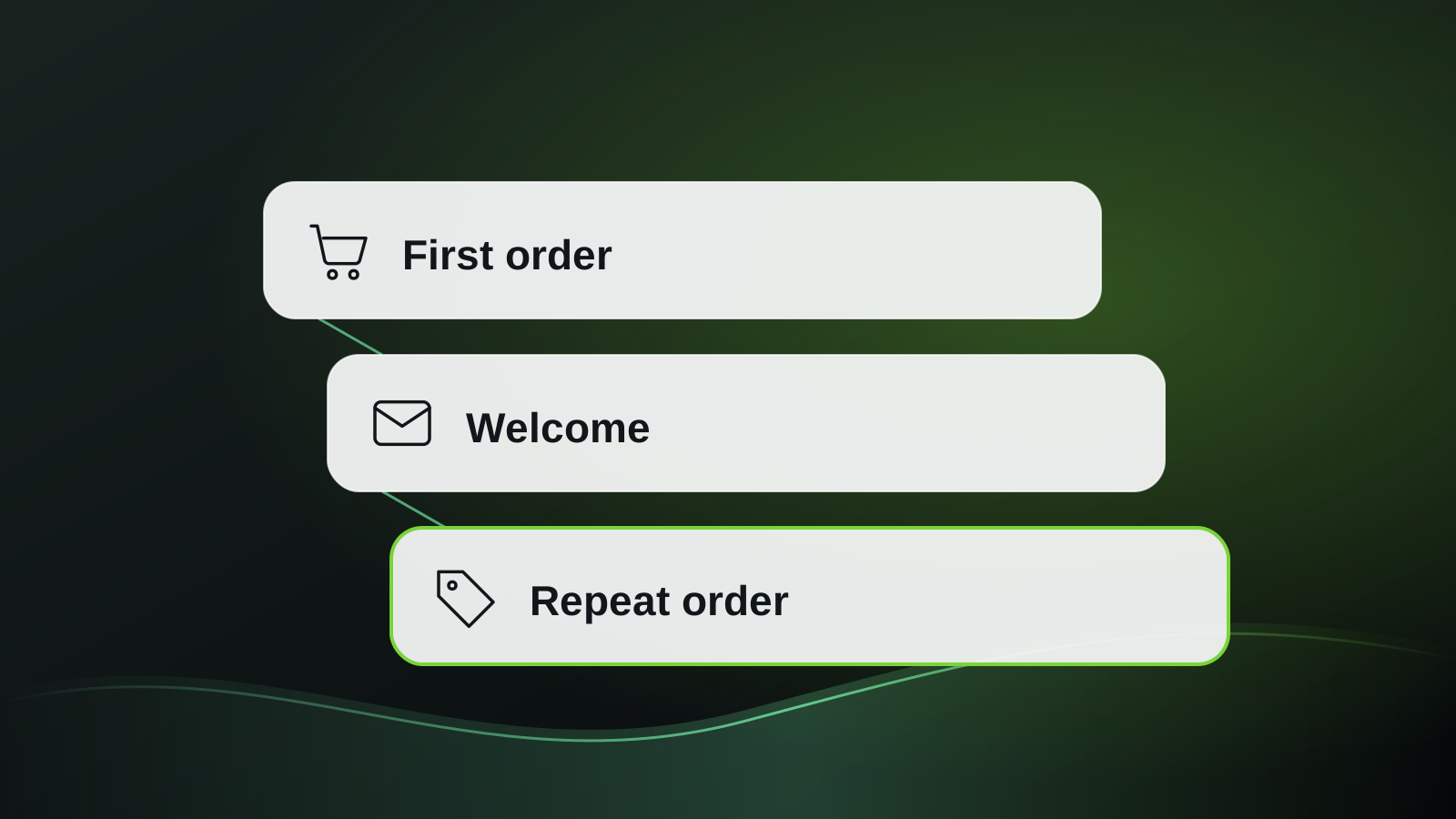
- Day 0: order confirmation with delivery date and tracking.
- Delivery day: dispatch and delivery updates.
- A few days after delivery: setup, care or how-to guidance.
- One to two weeks after delivery: a specific review request.
- Three to six weeks after delivery: a relevant second-purchase suggestion, timed to the product.
Use retargeting for those who do not return
Customers who open emails but do not buy can be reached again with retargeting, using the same product and a clear reason to come back. Only use retargeting where the customer has consented, and keep the frequency modest so it stays useful.
Use retargeting to support the email sequence, not to replace it. If a customer has not engaged with any email after the first month, a short retargeting burst with the product they bought, or the one most often bought next, can bring them back without adding to their inbox.
Measure repeat purchase, not only opens
Open rates are a weak measure of a post-purchase sequence. The DMA's 2025 benchmark, built from anonymised data from seven UK email service providers, reported an average open rate of 35.9%, a unique click rate of 2.3% and a delivery rate of 98% for 2024 (DMA, 2025). But Litmus data for September 2026, based on more than 1.5 billion opens, attributes 76.56% of opens to Apple clients, and Litmus says opens from users with Apple's Mail Privacy Protection are not reliable (Litmus, 2026). Many recorded opens are machines loading images, not people reading.
Track the repeat purchase rate at 30, 60 and 90 days, the revenue per customer and the unsubscribe rate. If repeat purchase rises while unsubscribes stay low, the sequence is working. Where you can, hold back a small control group that does not receive the sequence, so you can see how many second orders it actually caused rather than how many would have happened anyway.
What good looks like is a sequence that is short, timed to the product, and reviewed against repeat purchase every quarter. For example, a hypothetical skincare brand might find that customers who receive a how-to email after delivery reorder at a higher rate than a control group, while a later discount email adds little. That result would argue for more help content and fewer offers, which is the opposite of what many brands assume.
- Repeat purchase rate at 30, 60 and 90 days after the first order.
- Revenue per customer over 12 months, compared with a control group.
- Clicks and orders per email, rather than opens.
- Unsubscribe and spam complaint rates for each email in the sequence.
Common mistakes, and what to ask a supplier
The usual mistakes are sending a discount in the first email, which teaches customers to wait for offers; asking for a review before the product has arrived; sending the same cross-sell to everyone regardless of what they bought; and reporting success on open rates. Another is letting the sequence run unchanged for years while the product range moves on.
If you are working with an agency, ask how they will time each email to your products, how they will measure repeat purchase against a control group, how they will handle consent and the soft opt-in rules, and how often they will review and refresh the sequence. Good answers focus on second orders and customer value, not on open rates.
Put this into practice
Book a discovery call and we will review your channels and results first, then agree what to test.
Plan your email programmeQuestions and answers
How many emails should a post-purchase sequence have?
Three to five is typical: a confirmation, a setup or care email, a review request and one or two second-purchase suggestions. Each one should earn its place by helping the customer, not just reminding them of the brand.
Should every customer get a discount?
No. Discounts train customers to wait for offers. Use them selectively, for example to recover a lapsed customer, and keep the first sequence focused on value, such as help with the product and relevant suggestions.
Can we email customers without asking for consent?
In the UK, the soft opt-in usually lets you email existing customers about similar products, if you offered a clear chance to refuse marketing when collecting their details and every email includes an opt-out. The ICO is reviewing its guidance after the Data (Use and Access) Act 2025.
Are open rates still useful?
Only as a rough signal. Litmus attributes most opens to Apple clients and says opens from users with Mail Privacy Protection are not reliable. Clicks, orders and repeat purchase rate are better measures of whether a sequence works.
When should we ask for a review?
After the customer has had time to use the product, usually one to two weeks after delivery. Ask a specific question about the product. Research from Northwestern University found that the first few reviews have a large effect on whether other shoppers buy.
References
- Harvard Business Review, "The value of keeping the right customers", 2014
- DMA, "Consumer Email Tracker 2023", 2023
- ICO, "Electronic mail marketing" (Guide to PECR), 2026
- Baymard Institute, "Cart abandonment rate statistics", 2025
- Spiegel Research Center, Northwestern University, "How online reviews influence sales", 2017
- DMA, "Email Benchmarking Report 2025", 2025
- Litmus, "Email client market share", 2026
- ONS (Office for National Statistics), "Internet sales as a percentage of total retail sales (ratio) (%)", 2026

 Alexander