What repeat-purchase email is, and how it differs from the newsletter
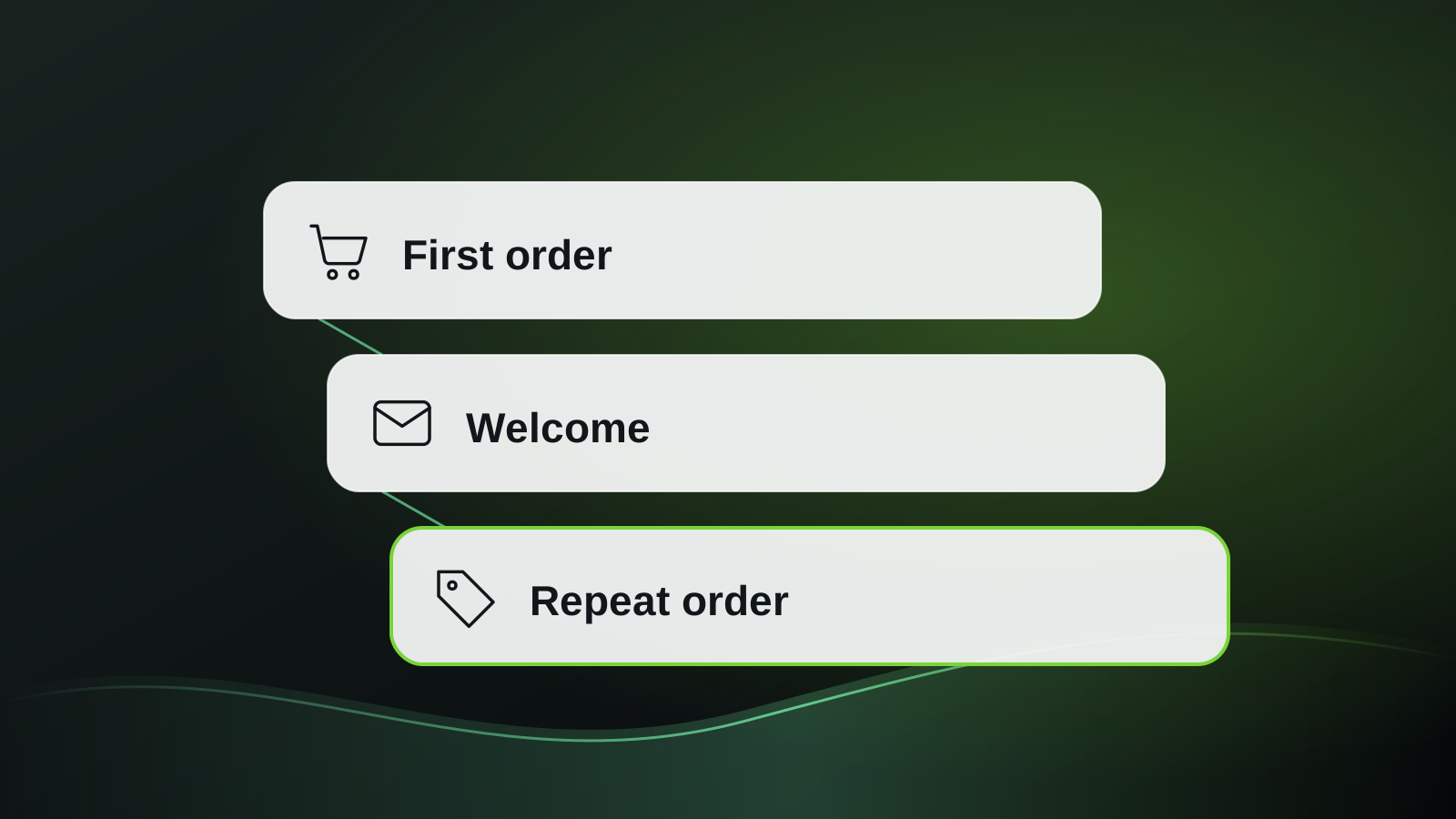
Most retailers send two kinds of email. Campaigns go to the whole list, or a large part of it, on a date the business chooses: a sale, a new range, a seasonal edit. Flows are automated messages triggered by something a customer did or is likely to do next. Repeat-purchase email sits almost entirely in the second group. It uses the order history you already hold to send a message at the moment a second order becomes likely.
This post covers three flows that matter most for retailers after the first sale: replenishment, back-in-stock and category flows. It does not repeat the post-purchase sequence covered in email after the first order, which deals with confirmation, set-up and reviews. Here the focus is the second, third and fourth order, and the segmentation that makes those messages relevant.
The difference matters because the two kinds of email are judged differently. A newsletter is judged on reach. A flow is judged on whether the person who received it bought again, and whether they would have done so anyway.
Why it matters: the data on flows, frequency and fatigue
Online is now a large, settled share of retail. Internet sales were 28.3% of all retail sales in Great Britain in September 2026 (ONS, 2026). With that much trade online, the cost of winning each new customer through paid media makes the second order the point where many retailers start to make money on a customer.
Vendor data shows how much of email revenue comes from automation. Klaviyo reports that campaigns make up 94.7% of send volume across its customers, yet flows produce nearly 41% of email revenue from just 5.3% of sends, with revenue per recipient for flows nearly 18 times that of campaigns (Klaviyo, 2026). This is a vendor benchmark drawn from its own customer base, so treat it as an indication of direction rather than a market average.
Sending more is not the answer. In a ZeroBounce survey of 1,091 people across the US, Canada, Australia, India, Israel and parts of Europe, 43% said the main reason they unsubscribe is that a sender emails too often (ZeroBounce, 2026). That is a vendor survey across several countries, not a UK sample, but it matches what most retailers see in their own unsubscribe data after a heavy send period.
There is also a baseline for list health. Mailchimp's benchmarks put the average unsubscribe rate for ecommerce campaigns at 0.19%, with an average click rate of 1.74%, based on campaigns sent to at least 1,000 subscribers and last updated in December 2023 (Mailchimp, 2023). These are campaign figures from one platform, which makes them a useful floor for comparison rather than a target.
How the three core flows work
Replenishment. For anything that runs out, such as skincare, pet food, coffee, filters, vitamins or printer ink, the order date and the pack size tell you roughly when a customer will need more. The flow sends a reminder shortly before that point, with a one-click route back to the same product. The timing should come from your own data: the median gap between first and second orders for that product, not a guess.
Back-in-stock. When a customer asks to be told when an out-of-stock size or colour returns, they have told you exactly what they want. The flow sends one message when stock lands, and perhaps one reminder if stock is limited. It should only fire when enough units are available to meet the likely demand, or the email creates disappointment instead of a sale.
Category flows. A customer who bought a tent may need sleeping bags; one who bought a pram may need a car seat later. Category flows use the first purchase to suggest the next logical one, with a delay that reflects how the product is used. They work best with a short, hand-built map of which categories lead to which, checked against what customers actually buy next.
- Replenishment: trigger on order date plus typical usage period for the product and pack size.
- Back-in-stock: trigger on stock arrival for a requested item, with a minimum stock threshold.
- Category: trigger on first purchase in a category, with a delay set by how the product is used.
A method you can follow: segment by purchase history
Start with the order data, not the email tool. Export orders for the past two years and work out, for each main product or category, the share of customers who bought again and the median days between orders. This tells you which products have a natural repeat cycle and which do not. A retailer selling sofas and one selling dog food need very different plans.
Then build segments that the flows can use. Four are usually enough to begin: one-time buyers inside the expected repeat window, one-time buyers past it, repeat buyers, and lapsed customers who have not bought for longer than twice the usual gap. Add returns as a filter. Retail Economics forecasts that around 19.5% of non-food goods bought online will be returned in 2025, down from 21% in 2024 (Retail Economics, 2025). A customer who has just sent an item back should not receive a cross-sell for the same thing.
For example, a homeware retailer with 30,000 customers might find that buyers of candles reorder after about 60 days, while buyers of bedding rarely buy the same item again but often buy towels within three months. That points to a replenishment flow for candles and a category flow from bedding to towels, each with its own timing. This is a hypothetical example, but the method is the same for any range.
Check the legal basis before you send. Under the UK rules on electronic marketing, the soft opt-in lets you email existing customers about similar products only if you gave them a simple way to refuse when you collected their details, and you repeat that choice in every message (ICO, 2026). If you are unsure whether a segment qualifies, leave it out.
How to measure it: repeat rate, revenue per recipient and unsubscribes
Opens are no longer a reliable measure. Litmus reports that Apple Mail accounted for 76.56% of tracked opens in September 2026, and that Apple's Mail Privacy Protection affects roughly 55% to 60% of all opens (Litmus, 2026). Because the privacy feature can register an open without a person reading the email, open rates now say more about the mix of devices on your list than about interest.
Use three measures instead. Repeat purchase rate is the share of first-time buyers who place a second order within a set window, such as 90 or 180 days. Revenue per recipient is the revenue a flow produces divided by the number of people who received it, which lets you compare flows of very different sizes. Unsubscribe rate per flow tells you whether the message is welcome. Track spam complaints too: Gmail requires senders of 5,000 or more messages a day to keep their reported spam rate below 0.3%, recommends staying below 0.1%, and requires one-click unsubscribe on marketing email (Google, 2026).
Finally, test for incremental effect. Hold back a random 10% of eligible customers from each flow and compare their repeat rate with those who received it. Without a holdout, a replenishment flow will take credit for orders that loyal customers would have placed anyway.
Common mistakes, and what good looks like
The most common mistake is timing set by guesswork: every replenishment reminder at 30 days, whatever the product. The second is sending flows on top of a full campaign calendar, so that a customer receives a reminder, a sale email and a newsletter in the same week. Set a contact cap across flows and campaigns, and let flows take priority because they are more relevant.
Other mistakes are quieter. Back-in-stock emails that fire for two units of stock. Category flows that recommend a product the customer has already bought. Discount codes in every flow, which teach customers to wait for one. Reports that show revenue attributed to email without any holdout, so nobody knows what the flows really add.
Good looks like a small number of flows, each with timing drawn from order data, each reported on repeat rate and revenue per recipient against a holdout group. Unsubscribe and complaint rates stay low and steady. The list grows healthier over time because people receive fewer, more useful emails. Email then works alongside retargeting and the rest of your ecommerce plan, rather than carrying every sale on its own.
What to ask an email supplier
Whether you use an agency or an in-house team, the questions are the same. They should be able to answer each one with your data, not with a generic benchmark.
Pay particular attention to how they report. A supplier who leads with open rates, or with attributed revenue but no holdout, is measuring activity rather than results.
- How will you set the timing of each flow, and which order data will you use?
- How will flows and campaigns share a contact cap, and which wins when they clash?
- Will every flow have a holdout group, and how big?
- How will you report repeat purchase rate and revenue per recipient by flow?
- How will you check that each segment meets the soft opt-in rules?
- What spam complaint and unsubscribe rates would make you pause a flow?
Put this into practice
Book a discovery call and we will review your channels and results first, then agree what to test.
Talk about your retail email flowsQuestions and answers
What is a replenishment email?
A replenishment email is an automated reminder sent when a customer is likely to be running low on a product they bought, such as coffee, pet food or skincare. The timing comes from the order date, the pack size and the usual gap between orders for that product.
How do you measure whether repeat-purchase emails work?
Measure repeat purchase rate, revenue per recipient and unsubscribe rate for each flow, and compare customers who received the flow with a random holdout group who did not. Open rates are unreliable because privacy features on Apple devices can register opens automatically.
How often should a retailer email existing customers?
There is no single right number, but frequency is a leading reason people unsubscribe. Set a weekly or monthly contact cap across all flows and campaigns, give triggered flows priority over general campaigns, and watch unsubscribe and complaint rates for each send.
Can a retailer email past customers without fresh consent?
Under the UK soft opt-in, a retailer can email existing customers about similar products if it offered a simple way to refuse marketing when it collected their details and offers the same choice in every message. The rule does not cover bought-in lists or prospects.
Should back-in-stock emails include a discount?
Usually not. A customer who asked to be told when an item returns has already shown strong intent, so a discount often gives away margin on a sale that would have happened anyway. Make sure enough stock has arrived to meet demand before the email is sent.
References
- ONS (Office for National Statistics), "Internet sales as a percentage of total retail sales (ratio) (%)", 2026
- Klaviyo, "Email marketing benchmarks by industry 2026"
- ZeroBounce, "Into the Inbox: Email Marketing Statistics for 2026", 2026
- Mailchimp, "Email Marketing Benchmarks and Industry Statistics", 2023
- Retail Economics and ZigZag, "ZigZag returns benchmark 2025", 2025
- ICO, "Electronic mail marketing" (Guide to PECR), 2026
- Litmus, "The State of Email Client Market Share", 2026
- Google, "Email sender guidelines" (Gmail Help), 2026
 Alexander