What a franchise AI audit is, and why a one-off check misleads
Most franchisors who look at AI assistants do it once: someone types the brand name into ChatGPT, reads the answer and either relaxes or panics. That single answer tells you very little. AI assistants generate each response afresh, so the same question can produce a different shortlist, a different description and different sources a minute later. An audit replaces that one glance with a sample large enough to trust.
The evidence on variation is striking. A study by SparkToro and Gumshoe.ai, run in November and December 2025, put 12 brand-recommendation prompts through ChatGPT, Claude and Google's AI results between 60 and 100 times each; ChatGPT and Google returned the same list of brands less than 1% of the time, and the same list in the same order less than 0.1% of the time (Search Engine Journal, 2026). The study was not peer-reviewed and one of its authors sells tracking tools, but its practical conclusion was that the share of runs in which a brand appears held up far better than any ranking position.
For a franchise network there is a second reason to audit properly. You are not one business but many locations, often with local pages, local reviews and local press. An assistant may describe the brand correctly and still get a territory, a fee or a site wrong. The audit needs to cover the brand, the offer to franchisees and, where relevant, the customer-facing locations. If you want the wider picture of how assistants choose franchise brands, start with being recommended by AI assistants when someone looks for a franchise.
Why it matters: accuracy and trust in AI answers
Errors are common enough to plan for. An international study coordinated by the EBU and led by the BBC reviewed more than 3,000 answers from ChatGPT, Copilot, Gemini and Perplexity and found that 45% had at least one significant issue, 31% had serious sourcing problems and 20% had major accuracy problems; Gemini had significant issues in 76% of its answers (Advanced Television, 2025). The questions were about news rather than franchising, but the failure modes, outdated details and wrong attribution, are the same ones that affect a franchise listing.
People act on these answers. BrightLocal's 2026 survey of 1,002 US adults found that 63% of people who use AI tools for business recommendations trust those recommendations, while 88% say they fact-check the sources (BrightLocal, 2026). In the UK, Ofcom reports that about 30% of Google searches now show an AI overview and 53% of adults say they see these summaries often (Ofcom, 2025). And Pew's analysis of 68,879 searches by 900 US adults found that about 18% produced an AI summary, with longer, question-style searches more likely to trigger one (Pew Research Center, 2025). Franchise research is full of long questions.
Step one: choose the prompts
Build a fixed prompt set and keep it stable, so that month-on-month changes reflect the assistants, not your wording. Write prompts the way buyers and customers actually ask, in full sentences. Use your discovery-call notes, enquiry forms and sales team to find the real phrasing, and include the awkward questions about complaints and failure rates as well as the flattering ones.
For example, a home services franchisor with 60 territories might use 30 prompts split across these groups:
- Category prompts: "What are the best home services franchises in the UK?"
- Budget prompts: "Which franchises can I start for under £30,000?"
- Suitability prompts: "What franchise suits someone leaving a corporate job?"
- Location prompts: "Are there franchise opportunities available in Bristol?"
- Brand prompts: "Is [brand] a good franchise to buy?", "How much does a [brand] franchise cost?", "What do franchisees say about [brand]?"
- Comparison prompts: "[Brand] or [competitor]: which franchise is better?"
- Customer prompts, if your sites serve the public: "Best [service] near [town]".
Step two: sample, repeat and record
Run each prompt in each assistant you care about, typically ChatGPT, Google AI Overviews or AI Mode, Gemini, Copilot and Perplexity. Run each prompt several times, in fresh sessions and without being signed in where possible, so earlier conversations do not colour the answer. Five runs per prompt per assistant is a workable minimum for a monthly check; more runs give steadier percentages. Google notes that its AI features may issue several related searches behind the scenes to build a response (Google Search Central, 2026), which is one reason answers drift between runs.
For every run, record the same fields in a spreadsheet:
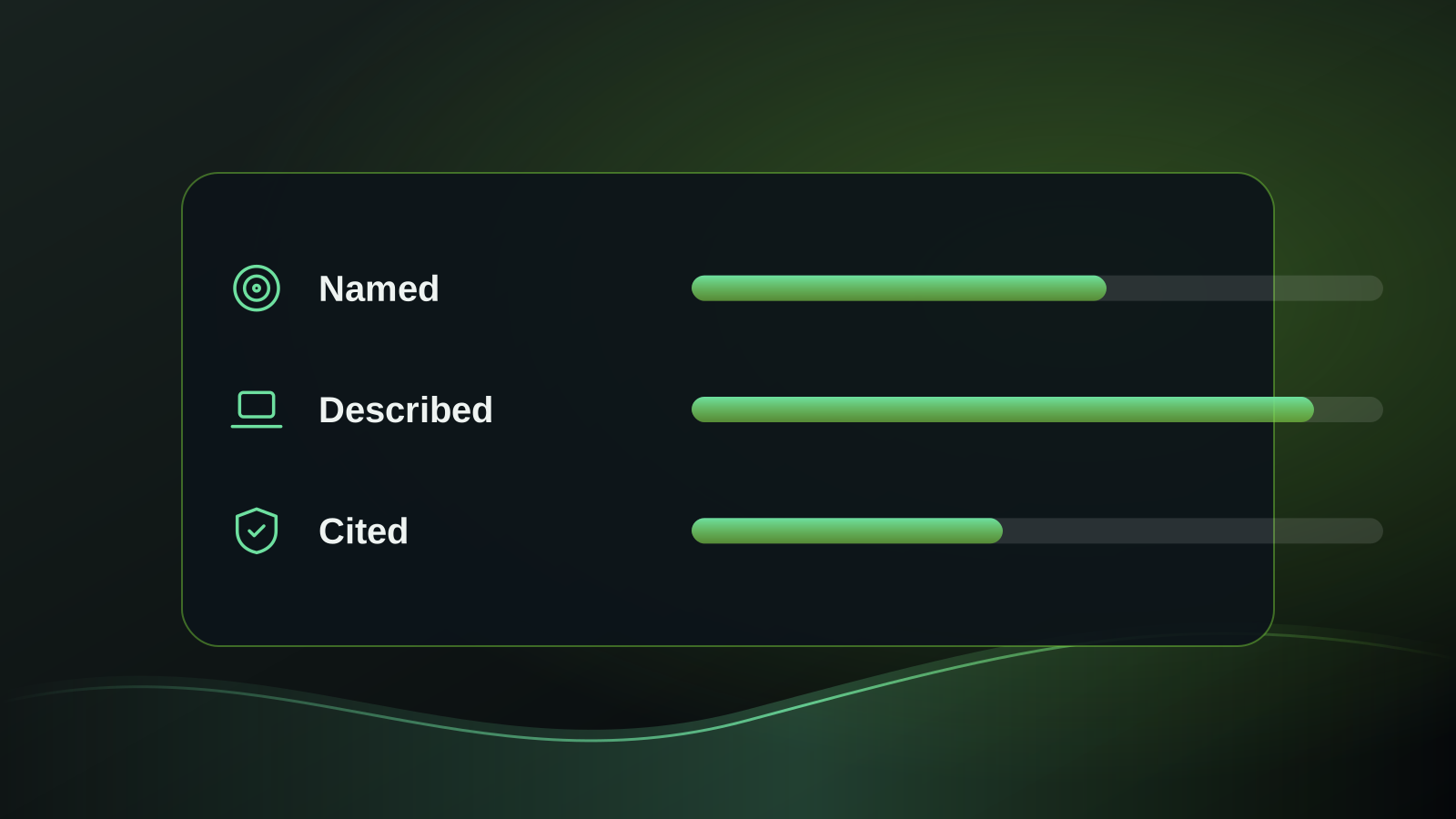
- Named: was the brand mentioned at all, and which competitors were named alongside it?
- Described: what did the answer say about investment, fees, support, territories and franchisee satisfaction?
- Cited: which URLs or publications were linked or named as sources?
- Wrong: any fact that is out of date, incorrect or missing, with the correct version alongside.
- Tone: positive, neutral or negative, with the phrase that set it.
Step three: read the results and trace wrong answers to their source
Summarise each prompt group as a share of runs: named in 12 of 25 runs, described correctly in 9, cited your own site in 4. Track those numbers over time rather than reacting to a single answer. Expect variation between assistants too; they draw on different indexes and weight sources differently, so a brand can be strong in one and absent in another.
The most valuable column is "wrong". Every error has a source. When an assistant says your initial investment is £10,000 lower than it is, look at the cited pages and search for the figure: it is often an old directory listing, a news story from several years ago, or an outdated PDF on your own site. Fixes then fall into a short list: update or remove the stale page, ask the directory or publisher to correct it, publish a clear, current page that states the fact in plain words, and make every listing agree. Where satisfaction is the issue, the BFA's 2024 survey offers useful context: 82% of franchisees said they were satisfied with their franchisor (Franchise Direct, 2024). That is a sector average, not evidence about your brand, so the fix for a negative description is honest franchisee testimony and public, factual replies to criticism.
Prioritise fixes by impact: errors on cost and earnings first, because they affect buyer decisions and carry regulatory risk, then missing mentions in category and budget prompts, then tone. On earnings, UK guidance expects business opportunity claims to reflect what an average participant is likely to achieve, backed by robust evidence (ASA, 2026), so an assistant repeating an old "up to" figure is worth correcting quickly.
How to measure progress, and common mistakes
Report four numbers each month for each prompt group: share of runs in which the brand is named, share described correctly, share citing a source you control or trust, and number of open errors. Tie them to recruitment by adding "AI assistant" to the "how did you hear about us" question and tracking enquiries, discovery days and signed agreements from that source.
The mistakes are predictable. Teams run each prompt once and treat the result as a rank. They change the prompt wording every month, so trends mean nothing. They log mentions but not accuracy, so a brand that is named with the wrong fee looks like a success. They fix the symptom by complaining to the assistant rather than correcting the page behind it. And they audit only the brand, ignoring the territories and local sites where most errors sit.
What good looks like, and what to ask a supplier
A good audit is boring in the best sense: the same prompts, the same assistants, the same fields, every month, with a short log of what was fixed and what changed afterwards. Over two or three cycles the share of correct mentions should rise and the error list should shrink. Our AI visibility report follows this structure, and the method compares closely with an AI visibility audit against competitors.
If a supplier runs the audit for you, ask how many runs they make per prompt and per assistant, and ask to see the raw answers, not only a score. Ask how they handle variation between runs, how they record accuracy, and how they trace an error back to its source. Ask what they will fix, who owns each fix, and how they will show whether it worked. Treat any tool that reports a single "AI rank" with caution: the evidence on run-to-run variation suggests it measures noise.
Put this into practice
Book a discovery call and we will review your channels and results first, then agree what to test.
Get an AI visibility report for your franchiseQuestions and answers
How many prompts should a franchise AI audit include?
Twenty to forty prompts is usually enough, spread across category, budget, suitability, location, brand and comparison questions. Keep the set fixed from month to month so that changes in the results reflect the assistants rather than new wording.
How many times should each prompt be run?
At least five times per assistant for a monthly check, in fresh sessions. AI answers vary between runs, so the share of runs in which your brand is named is more reliable than any single answer or position.
Which AI assistants should a franchisor audit?
Cover Google AI Overviews or AI Mode, ChatGPT, Gemini, Copilot and Perplexity. They draw on different sources, so a franchise brand can be well described in one assistant and missing or wrong in another.
What should we do when an AI assistant gets our fees wrong?
Find the source the assistant cited or relied on, which is often an old directory listing or article. Correct or remove it, publish a clear current page with the right figure, align all listings, then rerun the prompt.
How often should we repeat the audit?
Monthly works for most franchisors, with a fuller review each quarter. Repeat sooner after a fee change, a rebrand or a major press story, because those are the moments when outdated sources are most likely to cause errors.
References
- Search Engine Journal, "AI recommendations change with nearly every query: SparkToro" (SparkToro and Gumshoe.ai study), 2026
- Advanced Television, "Study: AI misrepresents news content 45% of the time" (EBU and BBC study), 2025
- BrightLocal, "Nearly half of consumers are asking AI for business recommendations" (Local Consumer Review Survey 2026), 2026
- Ofcom, "From apps to AI search: how the UK goes online in 2025" (Online Nation 2025), 2025
- Pew Research Center, "Google users are less likely to click on links when an AI summary appears in the results", 2025
- Google Search Central, "AI features and your website", 2026
- Franchise Direct, "The results are out: the BFA and NIC Services Group reveal the results of the 2024 National Franchise Survey", 2024
- ASA, "Recruitment and business opportunities: earnings claims" (CAP AdviceOnline), 2026
 Alexander